
Home Thin Films Detectors Sensors Spectroscopies Photo gallery
Basic Vacuum Technology
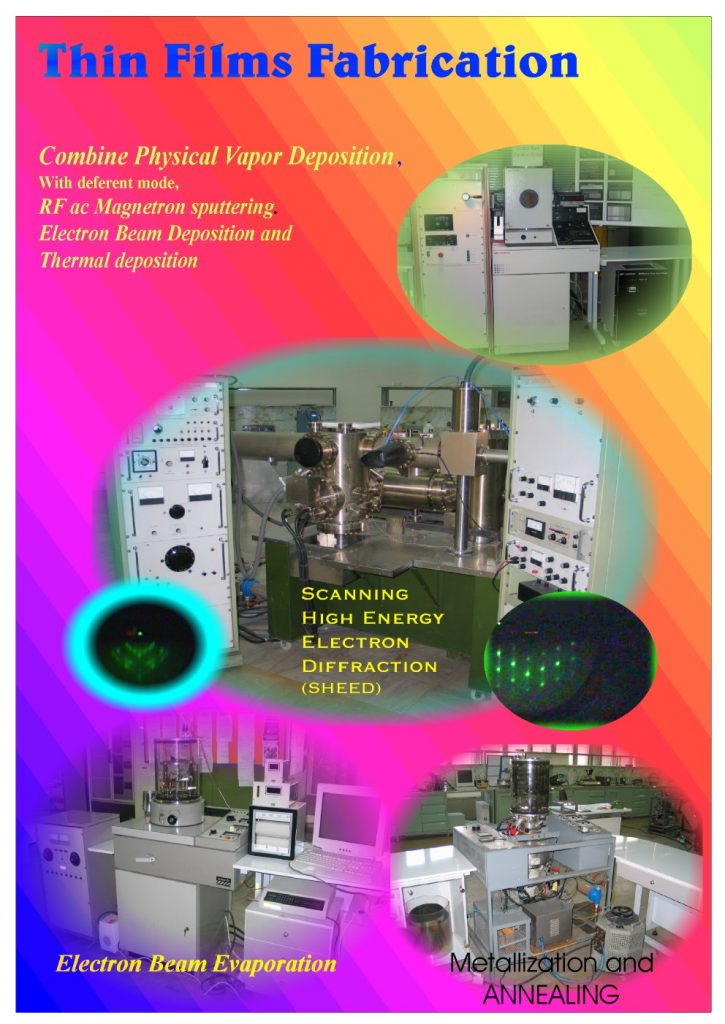
Thin Film
thin film characterization
Auger electron spectroscopy (AES)
Secondary Ion Mass Spectrometry (SIMS)
X-ray Photoelectron Spectroscopy (XPS, ESCA)
Semiconductor memory
is computer memory implemented on a semiconductor-based integrated circuit. Examples of semiconductor memory include static random access memory,
which relies on transistors, and dynamic random access memory, which uses capacitors to store the bits.
َ

Volatile
DRAM
SRAM
Z-RAM
TTRAM
Non-Volatile
ROM
PROM
EAROM
EPROM
EEPROM
Flash memory
FeRAM
MRAM
PRAM
SONOS
RRAM
NRAM
Memory
In psychology, memory is an organism’s ability to store, retain, and subsequently retrieve information. Traditional studies of memory began in the realms of philosophy, including techniques of artificially enhancing the memory. The late nineteenth and early twentieth century put memory within the paradigms of cognitive psychology. In recent decades, it has become one of the principal pillars of a branch of science called cognitive neuroscience, an interdisciplinary link between cognitive psychology and neuroscience
Contents
Processes
Classification
Sensory
Short-term
Long-term
Models
Multi-store (Atkinson-Shiffrin memory model)
Working memory
Levels of processing
Classification by information type
Classification by temporal direction
Physiology
Disorders
Memorization
Improving memory
Cultural references
References
See also
External links


Volatile
DRAM
SRAM
Z-RAM
TTRAM
Non-Volatile